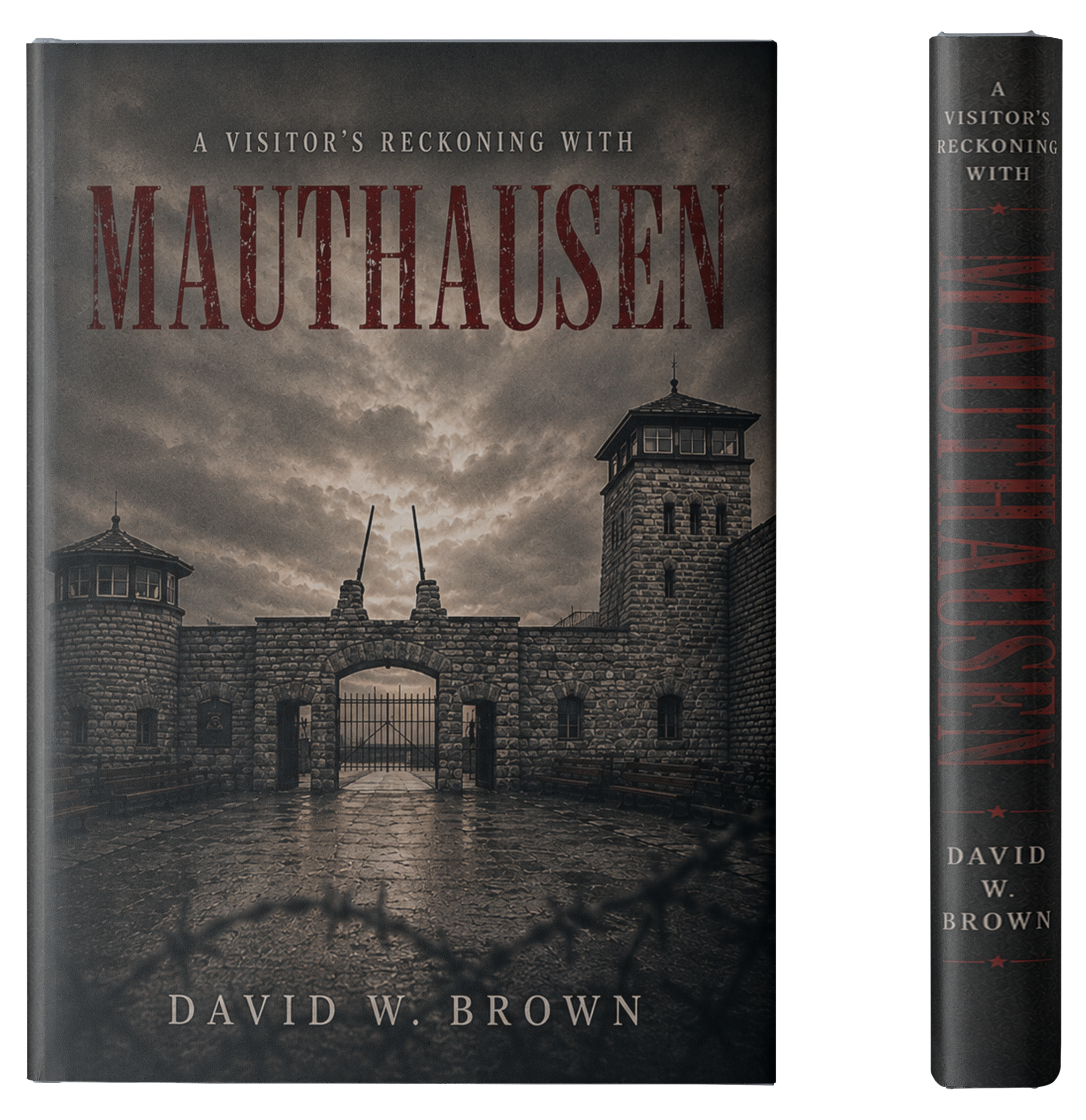
What does it mean to stand in a place built around suffering—and then walk back into the ordinary world?
In A Visitor’s Reckoning with Mauthausen, David W. Brown shares his personal experience visiting the Mauthausen Concentration Camp Memorial in Austria, confronting the physical reality of a place he had previously known only through history, photographs, and documentaries.
This is not simply a book about the past. It is a reflection on memory, humanity, obedience, silence, and the questions history leaves for us today.
Before visiting Mauthausen, David Brown knew the history in the way many of us do—from documentaries, photographs, books, and stories passed down through generations.
But standing inside the camp was different.
The history was no longer distant. It was physical. It was the stone beneath his feet, the barracks, the quarry, the stairs, the memorials—and the quiet realization that ordinary life and extraordinary cruelty had once existed side by side.
The book follows the path he walked through the memorial, using that journey as a way to explore what he saw, what he felt, and what questions remained after he left.
Explore the powerful narrative of an ordinary citizen confronting a place built entirely around suffering, labor, and death. Discover why ordinary life and extraordinary evil existed side by side, and what this painful piece of history asks of our humanity today.
A visit motivated by a desire to remember those who suffered and died at Mauthausen.
An honest account of the emotions and questions that emerged while walking through the memorial.
An invitation for readers to consider what history asks of us today.
The website should clearly distinguish the book’s personal/reflection-based approach from a conventional historical reference work.
The journey begins in Linz and continues toward the memorial.
The first encounter with the camp and the questions that immediately emerge.
Monuments representing victims from many nations.
A reflection on memory, education, and generations born long after the war.
The Quarry The granite quarry and the infamous “Stairs of Death.”
Daily life, overcrowding, starvation, fear, and survival.
A confrontation with individual lives behind historical numbers.
The reality of what occurred within the camp.
A place of remembrance and loss.
Leaving the physical site while carrying its questions forward.
What the experience made the author consider about the present.
The book turns toward reflection and personal responsibility.
At Mauthausen, the quarry became more than a historical location. Standing above it, the author began to understand the phrase “death through labor” not as an abstract historical term, but as a physical reality.
David lives in the United States with his wife. Together they traveled to Austria to visit the Mauthausen Memorial.
A Visitor’s Reckoning with Mauthausen is his first book.
David did not set out to write a conventional history of Mauthausen.
He wanted to record what happened internally when he walked through a place he had previously understood only from a distance.
The result is a personal reckoning—with memory, humanity, history, and the questions that remain after the visit is over.
A personal account of one man’s visit to the Mauthausen Concentration Camp Memorial—and the questions that followed him home.
Hear what readers and historians are saying about their profound experiences with this book.
The depth of emotion and reflection in every page is breathtaking. It feels as though the writer is speaking straight to your soul, capturing the heavy reality of history and leaving thoughts that linger long after the final page.
Enter David W. Brown’s personal reckoning with Mauthausen.
Find quick answers regarding book purchases, group orders, historical reflections, and how to connect directly with the author.
Which Genres Do You Write?
The book is a personal memoir and historical reflection focusing on World War II history, memory, and personal experience.
You can reach out directly using the contact form on the website to share your thoughts, questions, or inquiries.
No, it is a personal account and reflection of one man's visit to the Mauthausen Concentration Camp Memorial rather than a comprehensive history text.
Yes, rates are negotiable for groups and/or book clubs for purchases over ten books.
The author's lifelong study of WWII history—inspired by his grandfather, an Army veteran—and his actual visit to the Mauthausen Memorial in Austria with his wife.